
Profiles and window sill end pieces – what will influence appearance and durability?

A window sill is more than just a horizontal slab under a window. It is a visible element that people touch, that bears a functional load and that can either underline the architecture of the space or, conversely, disrupt it. In addition to the decor, the front edge profile – the “nose” of the window sill – is a key factor. It is decisive for:
how the window sill looks in a space;
comfort during use (e.g. resting elbows);
safety;
and also about the way the edges are finished.
At TOPSET, we offer six profile types, which are the result of combining design, practicality and installation experience.
Why not get your choice of profile right?
Aesthetics: the profile affects the overall style of a window sill and the entire wall that contains the window
Functionality: a deeper or higher nose protects the window opening and enables items to be stored
Installation and end pieces: different profiles require different types of end pieces – e.g. ABS edges, tape or plastic caps
You can find a complete technical overview on the page Types of TOPSET window sill profiles
Overview of TOPSET profiles and their characteristics
1. STANDARD
A classic rounded profile for universal use.
The most popular profile type in ordinary homes, apartments and commercial buildings.
Rounding with radius of R10 mm
Safe and comfortable to touch
Option of ending with caps, tape and ABS edges
Decors: white, wood, grey and concrete
2. LONG
An extended nose that protrudes further.
Great for situations where the window sill extends out of the window opening or serves as a shelf.
Larger nose depth: up to 45 mm
More robust appearance
Can be combined with HDF reinforcement for higher load-bearing capacity
End pieces: caps or tape
3. SLIM
A low and subtle profile for a minimalist solution.
Ideal for smaller window recesses and subtle interiors.
Nose height of just 17 mm
Very discreet solution
Recommended for bright or technical decors
End pieces: caps or tape
4. LINEAR
Straight end piece with ABS edges – for a clean architectural look.
The most popular profile with architects and interior designers.
A vertical end piece with an ABS edge in the same colour as the decor
No rounding = maximum modernity
Ideal for concrete, white and grey decors
Used exclusively with ABS end pieces
See reference uses of the Linear profile
5. DESIGN
A gently rounded modern profile – between a classic style and minimalism.
A great compromise for those who want elegance and soft lines at the same time.
Radius of R6 mm
A timeless look for every type of interior
Suitable for both laminates and wood decors
End pieces: tape or ABS edges
6. STYLE
A decorative and higher profile with a softly modeled shape.
Suitable for classic, rural and retro interiors.
A higher arch gives the impression of imposing size
Stronger end pieces for the window sill visible in the interior
Ideal for rustic and warm decors (Jura Cherry, Tennessee Walnut)
End pieces: caps or tape
End pieces for window sills – not just a technical detail
ABS edges
Elegant, durable and with a long service life
Produced to match the window sill decor
Can be used with Linear, Standard and Design profiles
Plastic caps
Quick-to-install end piece, easy fitting
Functional and common for classic profiles (Standard, Long, Style, Slim)
Edge banding tape
Aesthetically clean straight cut finish
Ideal for the SLIM, DESIGN and STYLE profiles
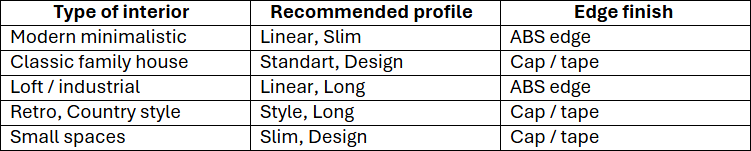
Which profile to choose for which interior?
Conclusion: A quality window sill starts with the right profile
TOPSET window sills are not just boards under a window – they are part of an interior.
By choosing a profile you determine their appearance, functionality and service life.
Choose not only according to the design, but also according to:
how often a load will be placed on the window sill,
what the depth of the recess is,
how you want it to appear at first glance.
